Manual Testing Training in Vadodara - Arth Training Institute
Master Manual Testing fundamentals, bug tracking & QA processes. Hands-on training for beginners & professionals. Get job-ready today!

Master Manual Testing fundamentals, bug tracking & QA processes. Hands-on training for beginners & professionals. Get job-ready today!
Our Manual Testing Training provides a step-by-step understanding of software testing concepts. You’ll learn how to design effective test cases, track defects, work with test management tools, and apply industry best practices. This program is ideal for beginners and career switchers aiming to build a strong foundation in Quality Assurance.
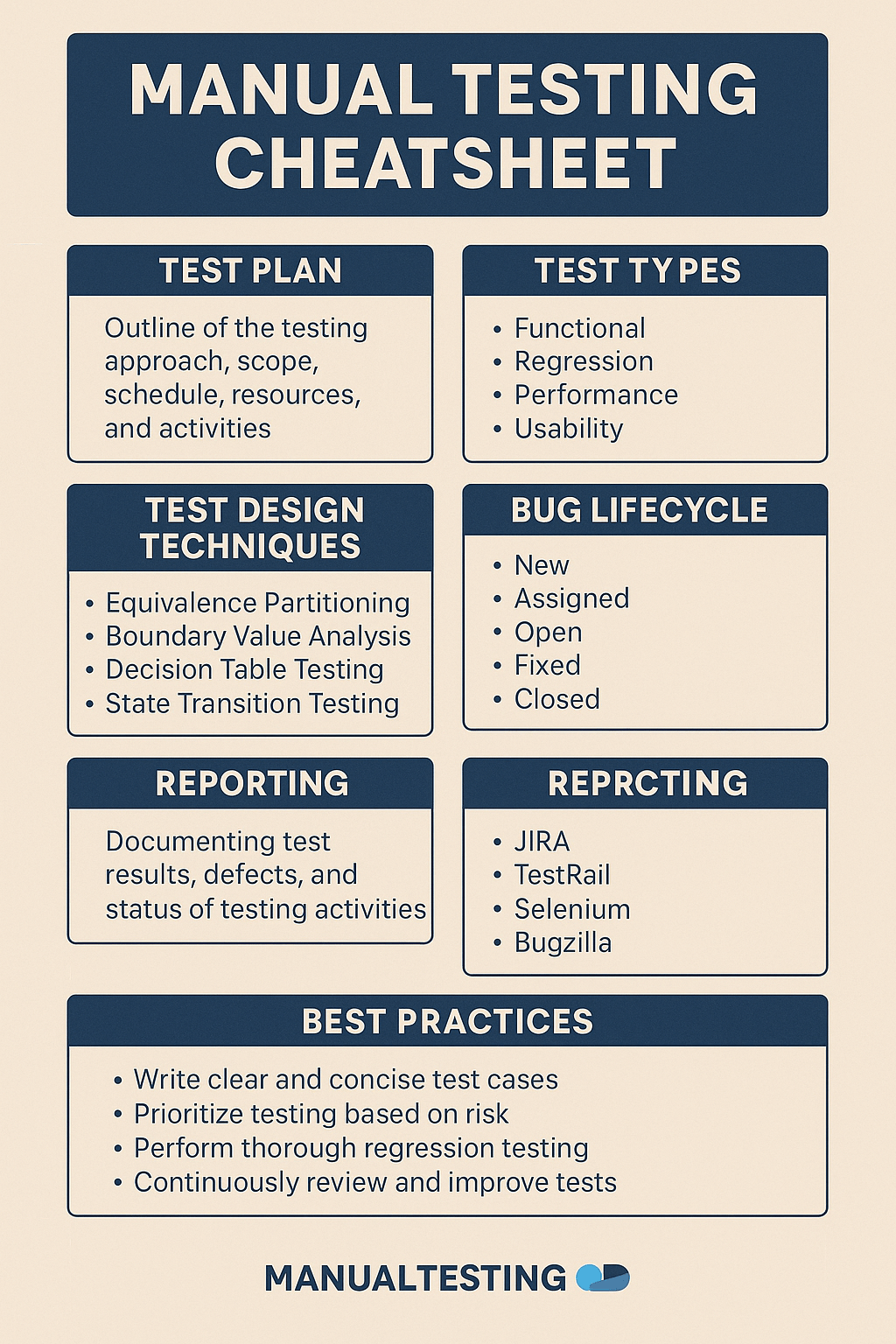
The Manual Testing course covers all essential aspects of software testing — from fundamentals to advanced testing techniques. You’ll explore test case design, defect lifecycle, black-box and white-box approaches, as well as real-world project practice with test management tools.
Learn the basics of software testing including types of testing (functional & non-functional), test documentation, defect lifecycle, and techniques like black-box and white-box testing.
Understand requirement analysis, test planning, test case design, execution, defect reporting, retesting, regression testing, and test closure.
Explore different testing types such as smoke testing, sanity testing, regression testing, exploratory testing, usability testing, and acceptance testing.
Work with tools like Jira, TestRail, Bugzilla, and apply techniques like boundary value analysis, equivalence partitioning, and state transition testing.
Follow a structured approach from basics to advanced concepts including test design, execution, defect management, and specialized testing.
Learn Jira basics, real-time usage, latest updates, and integration with modern workflows.
Get introduction to automation tools, API testing using Postman, and mobile application testing concepts.
Understand how ChatGPT helps in writing test cases, managing bug cycles, and improving testing efficiency.
At Arth Training Institute in Vadodara, the roadmap begins with understanding the importance of software testing, along with SDLC (Software Development Life Cycle) and STLC (Software Testing Life Cycle). This provides a clear overview of how testing fits into the software development process.
In this step, you will learn key concepts such as verification vs validation and QA vs QC. These fundamentals help you understand the quality assurance process and the role of a tester in software projects.
Test Documentation
You will learn how to create essential testing documents such as test plans, test scenarios, test cases, and RTM (Requirement Traceability Matrix). This step focuses on structured and professional testing practices.
Understand different types of testing including functional, non-functional, smoke, sanity, and regression testing. This helps you identify the right testing approach for different project requirements.
Learn techniques like equivalence partitioning and boundary value analysis. These are widely used methods for designing effective test cases without knowing internal code logic.
Explore white-box testing concepts such as statement coverage, decision coverage, and condition coverage. This helps in understanding testing from a developer’s perspective.
Understand the complete bug life cycle including defect reporting, tracking, severity, and priority. This step ensures you can manage and communicate issues effectively in real projects.
You will learn how to execute test cases manually, log results, perform retesting, and conduct regression testing. This is a core activity in real-world testing environments.
Get hands-on experience with tools like JIRA, TestRail, and Quality Center. These tools are used for managing test cases, tracking bugs, and collaborating within teams.
Learn flexible testing approaches such as exploratory and ad-hoc testing. These methods help identify unexpected issues and improve overall software quality.
Understand usability testing and user acceptance testing, where real users validate the application. This ensures the product meets business and user requirements.
This step covers final testing activities including test summary reports, metrics analysis, and lessons learned. It helps in evaluating the overall quality of the project.
Prepare for ISTQB certification by learning standard testing concepts, terminology, and exam patterns. This adds value to your professional profile.
Work on practical projects such as e-commerce websites and banking applications. This provides hands-on experience and helps build a strong portfolio.
In the final stage, you will prepare for QA interviews with mock sessions, resume building, and placement support at Arth Training Institute Vadodara, making you job-ready for software testing roles.
Learn from an industry expert with proven excellence in training, consulting, and mentoring.
Successfully completing this training will open the door to a wide range of QA and software testing career paths in IT companies and product-based organizations.
The fees for Manual Testing Training vary based on course type and learning mode:

